
Wetlands do not need to be flooded to provide the greatest climate benefit
Contrary to expectations, wetlands do not need to be completely flooded to provide the greatest climate benefit. Instead, the water table should be below the soil surface and remain stable, according to a new study from the University of Copenhagen. The greenhouse gas methane and microorganisms in the soil are “a game changer”.
Wetlands make up only about six percent of the land area but contain about 30 percent of the terrestrial organic carbon pool. Therefore, CO2 emissions from wetlands are central to the global climate balance. In Denmark, the plan is to flood 140,000 hectares of low-lying land such as bogs and meadows as part of the Green Tripartite Agreement.
Flooding such areas will slow down the decomposition of organic material in the soil and keep the CO2 in the soil rather than allowing it to be released to the atmosphere and contribute to the greenhouse effect. At least, that has been the rationale until now.
However, a new study from the University of Copenhagen, published in Nature Communications Earth & Environment, shows that this is not the best solution for the climate. By completely flooding low-lying areas, the optimal conditions are created for the formation of methane – a greenhouse gas that is up to 30 times more harmful to the climate than CO2.
"Most people currently expect that converted Danish low-lying soils will be flooded on a large scale. But our research shows that this is not a good idea. By keeping the water level slightly below ground level, methane produced can be partly converted to the less harmful greenhouse gas CO2 before it is released, thereby limiting methane emissions," says Professor Bo Elberling from the Department of Geosciences and Natural Resource Management, who led the study.
Microorganisms in the soil are an overlooked game changer
Other Danish researchers have mapped microbial life in Danish soils and found a total of 140,000 different species. Some of these microorganisms, which live in the upper soil layers, are the reason why flooding low-lying soils is not a good idea.
Here, methane-oxidizing microbes can convert methane produced deeper down in the very wet soil by other microorganisms, which otherwise would be released to the atmosphere. However, the conversion of methane only takes place if there is oxygen present in the soil. If the upper soil layers are flooded, they quickly become oxygen-free, and the conversion of methane stops.
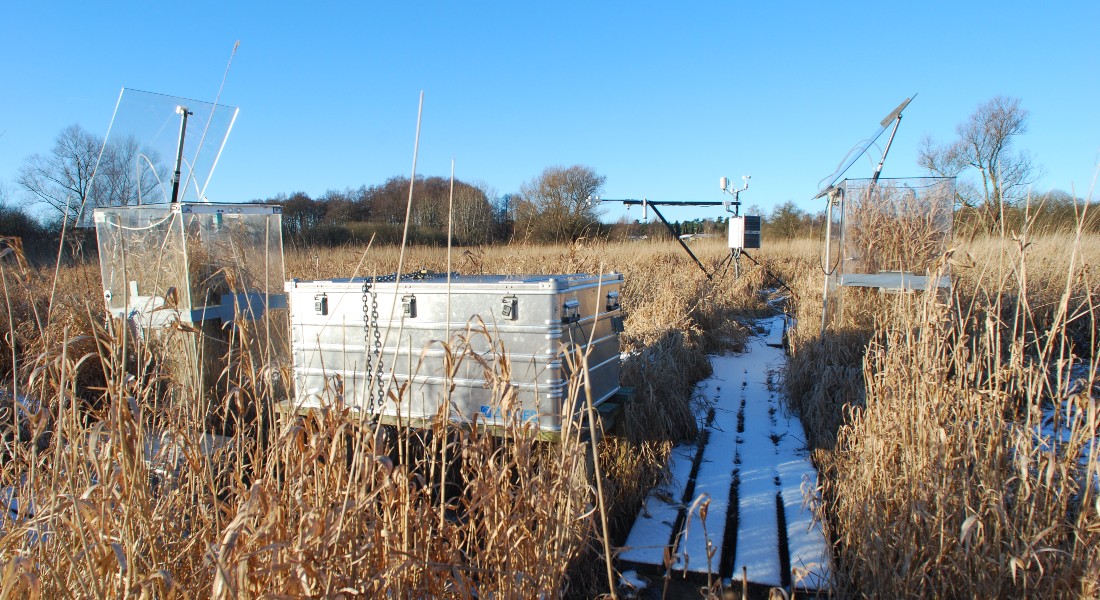
New knowledge is based on measurements and modeling in Maglemosen, a wetland located 20 kilometers north of Copenhagen, which has been undisturbed for more than 100 years and in many ways represents a typical Danish wetland with peat soils.
Here, Bo Elberling and his colleagues have measured CO2 and methane emissions from the soil continuously for several years and have now modelled a 16-year period from 2007 to 2023. The researchers also monitored the water level, plant life and soil and air temperatures. This large database was then used in a model to simulate observations and to investigate the most optimal water level in relation to the emission of both CO2 and methane.
"Based on our data from 2007 to 2023, we can see that the most climate-friendly water level in Maglemosen is around 10 centimeters below ground level. This is the level that overall provides the best balance between methane and CO2 emissions," says Bo Elberling.
The researchers emphasize that the precise recommendation of the depth of the water level will vary from wetland to wetland and will probably be somewhere between 5 and 20 centimeters below ground level. But the main point is clear:
"A stable water level below ground level will almost always provide the greatest climate benefit," says Bo Elberling.
Engineering task and Dutch experiences
The results thus point to a specific and stable water level in order to hit the climatic “sweet spot” between methane and CO2. According to the professor, this requires closer monitoring of the water level and some engineering work in order to both drain and supply the necessary water.
"It is clearly a challenge to ensure a stable water level in the new Danish wetlands. Optimum conditions require quite wet conditions but not water to the surface. So, what do you do, for example, in the dry summer months or in the autumn with heavy rain events?" says Bo Elberling.
However, according to the professor, the management of wetlands is far from an unknown problem, and there is some experience to be gained in both Denmark and other countries. He highlights the Netherlands, which is considered the world champion in keeping a constant water level. And, of course, the management of wetlands would ideally rely on green energy.
"The Netherlands would be under water if they did not constantly maintain a fairly stable water table. That is why we should look in that direction. We cannot just flood low-lying areas and then leave the water table to fluctuate freely. It will be a matter of using green energy, such as solar energy, to power pumps that can keep the water level stable," explains Bo Elberling.
Plant communities and nitrous oxide are also important factors
Changes in plant communities in new lowland areas are also important to consider. Some plants are good at transporting oxygen down into the soil and methane out into the atmosphere via their roots. This is included in the modelling work carried out in Maglemosen, where Canary grass dominates. Like rice plants, Canary grass is known for its ability to transport oxygen and methane within the plant itself.
"In Maglemosen, around 80 percent of the methane is released via the plants, and in particular Canary grass is expected to become more dominant in converted lowland areas in the future. Therefore, this plant species is likely to increase the transport of methane from the soil to the atmosphere, meaning that a smaller proportion of methane will be converted before being released," says Bo Elberling.
A stable water level is also crucial for keeping emissions low for another important and very potent greenhouse gas, namely nitrous oxide, which is about 300 times more powerful than CO2 over a 100-year period.
‘If the water level in flooded lowlands in the future is allowed to fluctuate at the whim of the weather gods, nitrous oxide emissions could significantly reduce the climate benefits,’ concludes Bo Elberling.
The researchers behind the study are Bingqian Zhao, Wenxin Zhang, Peiyan Wang, Adrian Gustafson, Christian J. Jørgensen and Bo Elberling. The researchers are affiliated with the University of Copenhagen, Department of Geosciences and Natural Resource Management, Lund University, Department of Physical Geography and Ecosystem Science, and Aarhus University, Department of Ecoscience.
Contact
Bo Elberling
Professor
Department of Earth Science and Environmental Management
University of Copenhagen
be@ign.ku.dk
+45 2363 8453
Michael Skov Jensen
KU Press
93 56 58 97
msje@adm.ku.dk