
European forests need to solve two crises – but not necessarily in one place
Forest areas can act both as carbon sinks and as vital habitats for thousands of species – but not necessarily at the same time. This has important implications for how Europe should manage its forests, says a University of Copenhagen researcher.
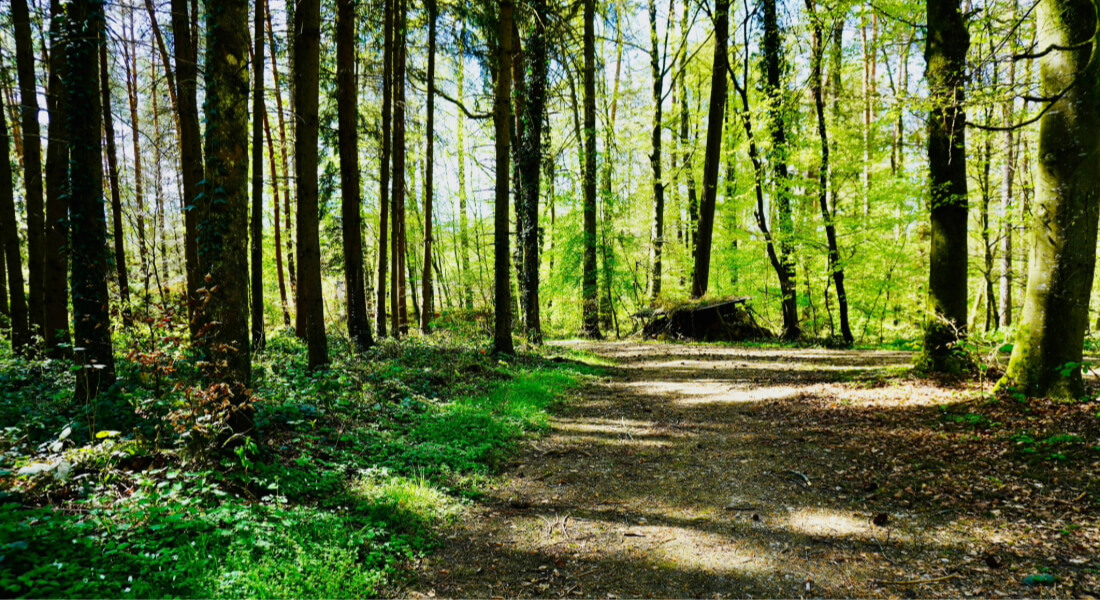
Trees are one of our most important weapons in the fight against CO₂ emissions and the resulting climate change. As trees grow, they absorb carbon dioxide from the atmosphere and store it as carbon in their trunks, branches, leaves and fruits. This process is most efficient early in a tree’s life, when growth is fastest.
Across Europe, large forest areas are being planted and managed with this purpose in mind. Trees of the same species are often planted in neat rows under plantation‑like conditions, where they efficiently absorb CO₂. Once they have passed their fastest growth phase – when they are also best at storing carbon – the trees are typically felled, making room for new trees that can grow and store even more CO₂.
This is a very effective way of managing forests that both store carbon and produce timber for industry. But there is one major problem, says associate professor Sebastian Kepfer‑Rojas from the University of Copenhagen. It only addresses one of the world’s two major environmental crises.
“We are facing two environmental crises. One is the climate crisis, and the other is the biodiversity crisis,” he says.
The problem with the types of forests described above is that, while they may be excellent carbon sinks, they do very little to support biodiversity. A one‑sided focus on carbon storage can lead to uniform forests with few species.
“The forest area in Europe has increased over the past 30 years, but that does not automatically mean that the ecological condition of forests has improved. Around 80 percent of the assessed European forests have a conservation status classified as ‘unfavourable’,” says Sebastian Kepfer-Rojas.
Dead trees are full of life
According to Sebastian Kepfer‑Rojas, the core problem with many European forests is that they are too homogeneous, too densely planted, and managed so that trees are planted and harvested at the same time – before they have a chance to die and fall naturally.
“High biodiversity requires variation across many different parameters; trees of different sizes, and a mix of living and dead trees,” he explains.
In Denmark, it has been decided that large parts of state‑owned forests are to be left unmanaged. The Green Tripartite Agreement (Den Grønne Trepart, ed.) also points towards large areas of current farmland being converted into so‑called ‘untouched forest’. This means that trees are not systematically harvested, but instead allowed to die and fall, creating habitats for a wide range of species – including fungi, insects and bats. In some places, trees are even deliberately damaged to speed up the formation of habitats for specific species.
“Even though Denmark does not have a large forest area, what we do here matters a great deal for biodiversity. I would actually say that Denmark is quite far ahead in this area. The issue has been taken seriously, and that sends a strong signal, but we are still a long way from where we need to be,” says Sebastian Kepfer‑Rojas.
Is a win‑win possible?
Is it possible to manage a single forest area so that it both functions optimally as a carbon sink and supports high biodiversity?
This is a key question being discussed by Sebastian Kepfer‑Rojas and his colleagues. Together with researchers from across Europe, he has co‑authored the scientific article ‘European forest carbon and biodiversity policies have a limited win‑win potential’.
In the study, the researchers examined a large number of European forests and analysed the relationship between carbon storage and biodiversity. The aim was to find out whether it is possible to strike a golden balance – a true win‑win – in forest management. In other words: can one forest be managed to optimise both carbon storage and biodiversity, or does this require different types of forests with different purposes?
As the title of the scientific article suggests, the researchers conclude that there are only limited opportunities to combine optimal carbon storage with high biodiversity in the same forest. While there was generally a positive relationship between biodiversity and carbon stored in dead wood, there was no clear link between high biodiversity and the amount of carbon stored in living trees.
Sebastian Kepfer‑Rojas and his colleagues therefore propose a triad approach to forest management, in which forests are managed in three different ways:
- Some forest areas should be optimised for timber production, while still ensuring a high and stable carbon store
- Some forest areas should be managed primarily to maximise biodiversity
- Some forest areas can function as test laboratories, where researchers continue to explore the potential for more balanced management approaches
“You could call it a diplomatic solution. But I think it is just as important to discuss where we do what. In some old forests, it makes sense to keep our hands completely off. In other areas, where the biodiversity potential is already low, intensive production forests may be appropriate. And then there are areas where close‑to‑nature forest management can be a good compromise,” says Sebastian Kepfer‑Rojas.
About the study
The scientific article ‘European forest carbon and biodiversity policies have a limited win‑win potential’ is published in the journal Nature Communications.
The study is the result of a large European research collaboration led by Italian researchers Lorenzo Balducci and Sabina Burrascano.
In total, data were collected from 99 forest sites in 12 European countries, covering more than 3,500 species. The researchers focused on six groups of organisms:
- Vascular plants
- Mosses and lichens
- Fungi
- Beetles
- Birds
The study also divides forest carbon into three biological categories in order to assess how biodiversity responds to different forest structures:
- Living trees (above‑ground biomass)
- Standing dead wood (dead, upright trees)
- Lying dead wood (fallen logs)
Topics
Contact
Contact
Sebastian Kepfer‑Rojas, Associate Professor
Department of Geosciences and Natural Resource Management
University of Copenhagen
Email: skro@ign.ku.dk
Mobile: +45 23 86 06 56
Jacob Heilmann‑Clausen, Associate Professor
Globe Institute, University of Copenhagen
Email: jheilmann-clausen@sund.ku.dk
Mobile: +45 23 83 99 97
Simon Thinggaard Hjortkjær, Communications Officer
University of Copenhagen – Communications
Email: sihj@adm.ku.dk
Mobile: +45 93 56 53 20